
Sengoku Jidai
Data packExplore a world inspired by Japanese history, culture, and mythology.
Why gradeA
How grades workStrengths
Points lost
- No place to report problems−3 points
- No release in 14 months−2 points
All 10 criteria
Maintenance
1 point lost26 / 27Last releaseHow long ago the newest file came out, or an existing file was marked as working on a new Minecraft version.14 months ago (12 Aug 2025) 11 / 12Supports popular versionsWhether the project has a file for a Minecraft version that 15% or more of the popular mods updated in the last 6 months also support. A version many modpacks use, like 1.20.1 or 1.21.1, also counts after a release in the last 12 months.Newest supported: 1.21.1. 15% or more of the popular mods updated in the last 6 months also have files for 1.21.1. Latest Minecraft: 26.3. 9 / 9Regular releasesIn how many of the last 24 months a new file came out. Full points at 3 months.Releases in 3 of the last 24 months 6 / 6Stability
Full points12 / 12Removed from modpacksHow many modpacks removed it in a later version of the pack. We can only see this in modpacks with two or more versions. A pack that swaps it for another edition of the same project, or that is rebuilt from scratch, does not count.Not measured yet.Quick fixesHow often a release needed a quick fix: a new release within 3 days to fix a problem in it.No quick fix in 2 years 7 / 7Known conflictsHow many projects say they do not work with it, compared with how widely it is used. Packs, small projects, forks, ports, add-ons, alternatives and old versions do not count.None 5 / 5Transparency
3 points lost0 / 3Source codeWhether the project page links to its source code, so anyone can read what it does.Does not apply. A data pack's files can be read in the download.Place to report problemsWhether the project page links to a place where players can report problems: an issue tracker or a Discord server.No link to report problems 0 / 3Popularity
Full points4 / 4DownloadsDownloads on Modrinth and CurseForge. Full points from 50,000.61,561 4 / 4Track record
1 point lost7 / 8AgeHow long the project has existed. It counts less when no new file came out recently.2.3 years, 8 releases 7 / 8
49 of the 54 points that apply = 91 out of 100.
Images


About
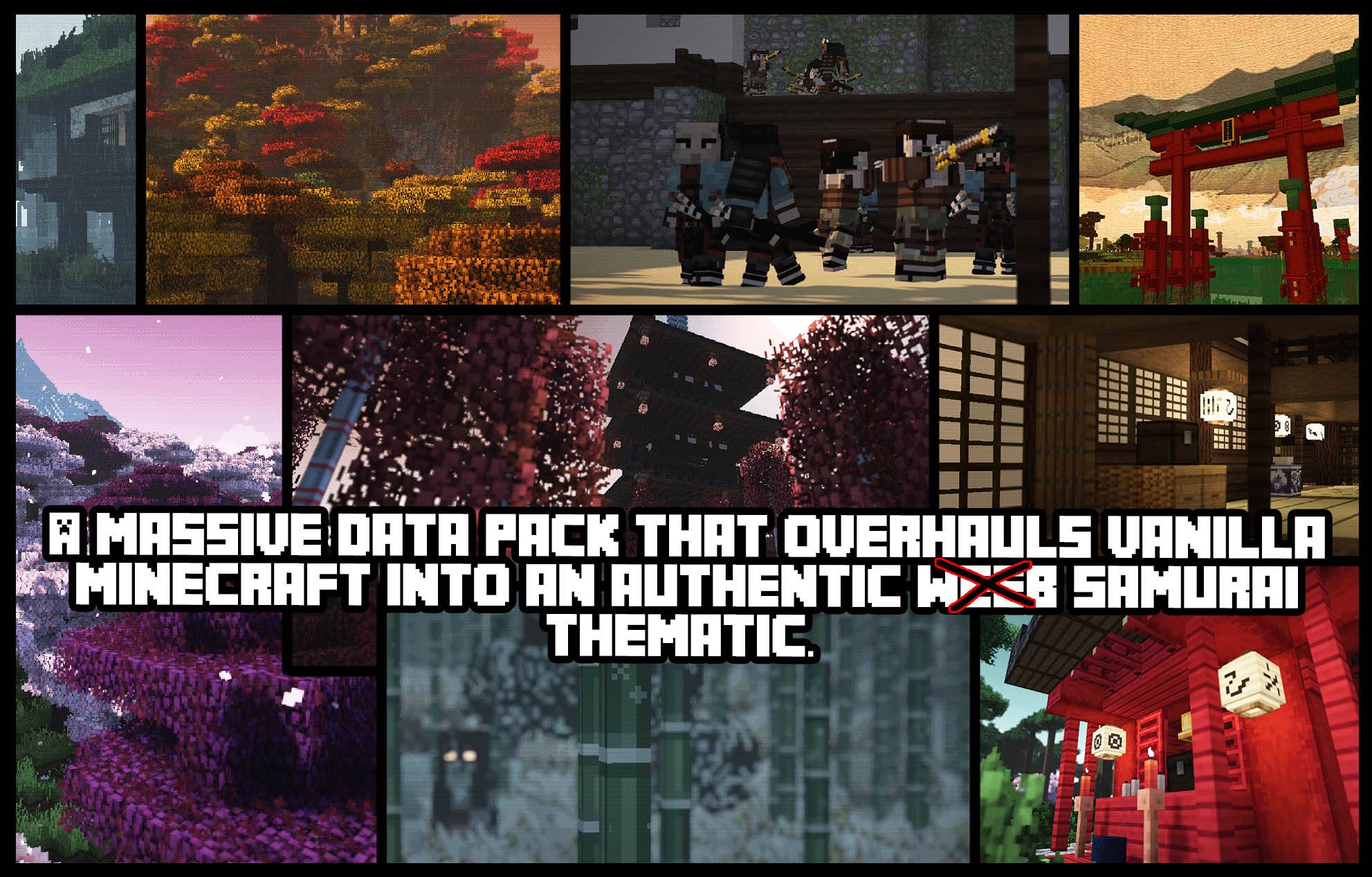
Sengoku Jidai transforms Minecraft into a Japanese history, culture, and mythology-inspired world by reworking its biomes, structures, creatures, blocks, items, recipes, sounds, and music. Its Overworld replaces many landscapes that do not fit the setting with temperate forests, mountain regions, and seasonal environments, including Sakura Grove, Shibazakura Plains, Harvest Fields, Sanguine Forest, Hot Springs, and snowy mountain biomes. The Nether becomes Yomi, a cold blue-green Land of the Dead with yokai such as Shikome, Yurei, and Wa nyūdō; along the Sanzu River, lost souls called Shiryō trade valuable artifacts. The End is recast as the ocean-filled Ryūgū-jō, where the Ender Dragon is replaced by the sea dragon Ryūjin and the dimension’s regions become reefs, highlands, and ocean. The world features Japanese-inspired settlements and landmarks, including minka villages, inns, shrines, pagodas, farmsteads, cemeteries, castle ruins, and castles, alongside themed replacements such as Oni Castles, Warlord Castles, and the Temple of Izanami. Creatures and people are rethemed as yokai, wildlife, and historical figures: examples include Kappa, Tengu, Oni, Kodama, tanuki, koi, samurai bandits, ashigaru bandits, and shinobi. The visual overhaul extends across building materials and everyday items, with woods such as Black Pine, Kiso Cypress, and Sakura; Shoji-style glass; Tatara furnaces; porcelain vases; and foods such as rice balls, miso soup, somen, and sushi cake. Weapons and equipment adopt Japanese names and designs, including bokken and katana swords, the Tanegashima crossbow, the Ame-no-Nuboko trident, shinobi gear, kabuto helmets, and omamori charms. Some recipes are changed to suit the theme or improve convenience, and the small, mouse-like Kodama Nezumi creeper retains its usual hitbox while having reduced health and spawn chances; gunpowder can also be crafted. The resource pack supplies the corresponding in-game names and visual changes, while the datapack handles the world and gameplay reworking.
Written from Modrinth . How we write it
In-game changes
Runs 92 function files: 1 every game tick and 1 when the pack loads. Its commands can remove entities, items or data and change game or server settings.
Changes world generation: terrain shape, 64 biomes, decorations such as trees and ores, 59 structures and 1 dimension.
Adds 166 recipes, 70 advancements, 22 loot tables, 120 tags, 35 recipe files, 14 other data files, 1 loot table file, 52 predicates, 1 item modifier and 9 more files in other folders.
Replaces 279 of vanilla Minecraft's world generation files, 251 structures, 112 recipes, 84 loot tables, 19 other data files and 5 tags.
Details
- Creator
- QwikSand
- License
- All rights reserved
- Downloads
- 62K
- Created
- 4 Jul 2024
- Official pages
- Modrinth , CurseForge
Security
No harmful code found
We checked what is inside its files, without opening them in the game.
Why we show this: a data pack cannot run programs, but its file can hide one. Our checks look for known signs of harm. They cannot prove that a file is harmless. In the grade: malware means no grade.
How we checked
- FilesWe download the files from Modrinth or CurseForge and look at what is inside them and what their code can do, without running them. Fixed rules tell what is harmful.3 latest files: the newest file for each Minecraft version and loader. All 3 are for recent versions. Recent versions: those released in the last 2 years, plus 1.20.1 and 1.21.1, among the most played in modpacks. See each file in Releases
- Author on ModrinthThe disclosure form on Modrinth, where the author declares that the project reads or edits things on your system outside the game. Since 13 Aug 2026, Modrinth's rules require it when this applies.Nothing declared about your system outside the game.
Privacy
Sends nothing
A data pack has no code that can connect to the internet, so it cannot send anything about you.
AI
No sign that AI was used to make it
We looked for AI tools in its texts, files and images and found none.
Why we show this: some players and servers avoid projects made with AI. Not in the grade: using AI does not tell whether a project works well or is kept up to date.
How we checked
- Author on ModrinthThe disclosure form on Modrinth. Since 13 Aug 2026, Modrinth's rules require it when a substantial part of the code is AI output, when an asset is mainly AI output, or when the project or its page relies on generative AI.No AI content declared.
- Description and changelogsThe description, project page and newest changelogs: sentences saying an AI tool was used, and text pasted from an AI chat.Nothing found2 of 12 changelogs read
- Its filesFiles that AI coding tools leave behind (like AGENTS.md), and the texts inside the files you download.Nothing found
- Images in its filesHidden data in the images of the files you download, where AI image tools write their name and settings.Nothing found1 image read
Compatibility
See all 8 filesPoint at or tap a version to see it.
Modpacks using this project
Modpacks that include Sengoku Jidai in at least one of their versions, most downloaded first.


Latest files
The newest file for each Minecraft version and loader. The files for recent versions come first. Recent versions: those released in the last 2 years, plus 1.20.1 and 1.21.1, among the most played in modpacks.