
Trim Resonance
ModEach armor trim material and pattern grants its own unique effect when worn.
Why gradeC
How grades workStrengths
Points lost
- No source code link−7 points
- First release only 6 months ago−4 points
- No public issue tracker−3 points
- Releases in only 5 of the last 24 months−2 points
- Under 5 million downloads−2 points
All 11 criteria
Maintenance
2 points lost25 / 27Last releaseHow long ago the newest file came out, or an existing file was marked as working on a new Minecraft version.6 days ago (18 Oct 2026) 12 / 12Supports popular versionsWhether the project has a file for a Minecraft version that 15% or more of the popular mods updated in the last 6 months also support. A version many modpacks use, like 1.20.1 or 1.21.1, also counts after a release in the last 12 months.26.3 on Fabric, NeoForge and Forge (latest) 9 / 9Regular releasesIn how many of the last 24 months a new file came out. Full points at 8 months.Releases in 5 of the last 24 months 4 / 6Stability
Full points22 / 22Removed from modpacksHow many modpacks removed it in a later version of the pack. We can only see this in modpacks with two or more versions. A pack that swaps it for another edition of the same project, or that is rebuilt from scratch, does not count.None of the 4 modpacks with two or more versions removed it 10 / 10Quick fixesHow often a release needed a quick fix: a new release within 3 days to fix a problem in it.1 of its 15 releases in 2 years needed a quick fix (7%) 7 / 7Known conflictsHow many projects say they do not work with it, compared with how widely it is used. Packs, small projects, forks, ports, add-ons, alternatives and old versions do not count.None 5 / 5Transparency
10 points lost0 / 10Source codeWhether the project page links to its source code, so anyone can read what it does.No link on the project page 0 / 7Place to report problemsWhether the project page links to a place where players can report problems: an issue tracker.No link to report problems 0 / 3Popularity
2 points lost2 / 4DownloadsDownloads on Modrinth and CurseForge. Full points from 5 million.15,534 2 / 4Track record
4 points lost4 / 8AgeHow long the project has existed. It counts less when no new file came out recently.6 months, 13 releases 4 / 8Security
PassedFile checksThis check adds no points. It can only take points away.Our checks found nothing harmful in all 8 latest files for recent Minecraft versions. See Security
53.4 of the 71 points that apply = 75 out of 100. The points above are rounded to whole numbers.
Images
About
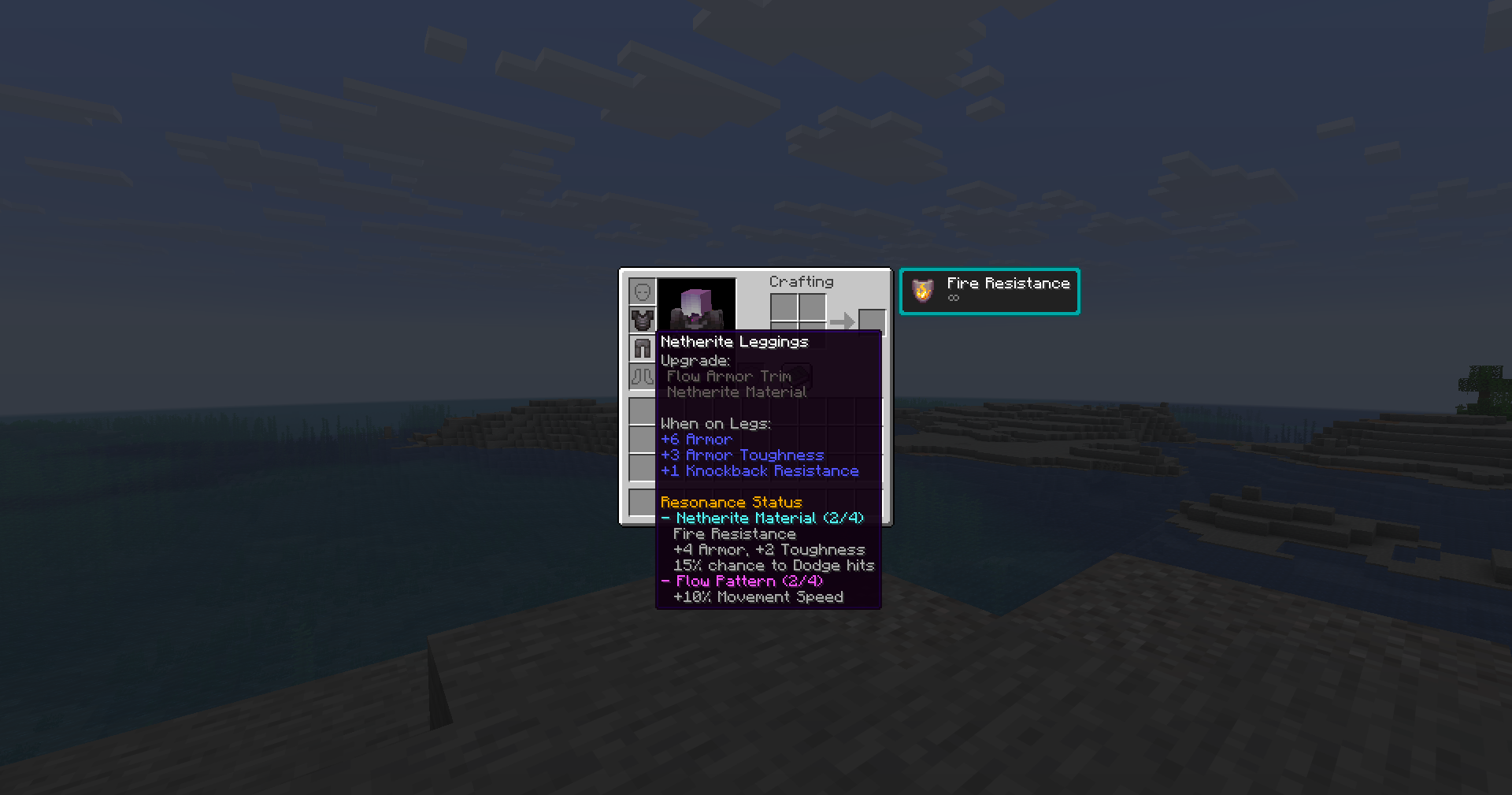
TrimResonance makes armor trims a progression system by giving worn trim materials and patterns distinct, stackable abilities. It uses two independent systems: material effects begin with one matching piece and scale across up to four, while pattern effects require at least two matching pieces and grow stronger with three or four. Material effects include Gold’s daytime Overworld bonuses to attack, speed, armor and attack speed, plus Piglin friendliness; Redstone’s movement-speed boost; Netherite’s Fire Resistance, armor, toughness and chance to negate damage; and Diamond’s incoming-damage reduction. Other materials support mining, combat and exploration in different ways: Iron grants mining efficiency and full-set Haste II, Copper makes fired projectiles call down lightning in thundering weather with sky visibility, Emerald discounts villager trades, Quartz increases XP gain, Lapis draws nearby XP orbs when worn as a full set, and Resin strengthens sneaking melee attacks. Amethyst combines a chance to negate incoming damage with a chance to amplify outgoing damage, which scales with the number of pieces worn. Pattern abilities add further effects, including Bolt’s Conduit Power in rain or water, Coast’s Dolphin’s Grace underwater, Dune’s heat protection and falling control, Eye’s low-light vision, Flow’s speed and step-height increase, and Host’s sneaking Slow Falling and protection from Phantoms. Other patterns cover strength and defense, mining, stealth, Nether and water survival, mobility, luck and regeneration: Raiser adds attack damage, Rib increases health, Sentry adds armor, Shaper grants Haste and mining efficiency, Silence grants sneaking invisibility, Snout offers Nether protection, Tide provides water breathing, Spire improves jumping, Vex grants speed and resistance, Wayfinder adds luck, Ward grants resistance, and Wild provides regeneration while hurt. Some abilities also affect mob behavior: with enough matching pieces, Dune can make Husks and Strays ignore the wearer, Eye can deter Evokers and Pillagers, Snout can deter Hoglins and Piglin Brutes, and Vex can deter Vexes. Tooltips show the active effects on trimmed armor, with detailed descriptions available on hover while holding Shift; the configuration lets players toggle each material or pattern independently and adjust numeric values, including through in-game Cloth Config editing.
Written from Modrinth . How we write it
In-game changes
Changes the game's code in 3 areas: Mobs and their behaviorChanges 8 game code files in this area: mobs, animals, villagers, projectiles and how they move and act., PlayerChanges 2 game code files in this area: your character: movement, abilities, hunger and controls. and Inventory and itemsChanges 1 game code file in this area: items, chests and other containers, crafting and enchanting..
Adds 9 advancements.
Counted from the names and data files in the mod, so the list may not be complete.
Keeps all of vanilla Minecraft's textures, models and sounds.
Details
- Creator
- unmasked917
- License
- All rights reserved
- Downloads
- 16K
- Created
- 19 Apr 2026
- Official pages
- Modrinth , CurseForge
- Links
- Discord
Security
No harmful code found
We checked its files and read their code, without running it.
What it can do on your computer
- Connects to the internet
- It has code that can go online, for example to check for updates, load skins or send crash reports. Only in its files for Fabric 26.2 to 26.3. See Privacy
- Creates settings files
- The mod keeps its settings in the config folder of your game, where you can change or delete them. 1 file in your config folder.
Why we show this: a mod runs on your computer like any program, so harmful code in it can take your accounts or files. Our checks look for known signs of harm. They cannot prove that a file is harmless. In the grade: malware means no grade, and a Warning in a latest file for a recent Minecraft version lowers it.
How we checked
- FilesWe download the files from Modrinth or CurseForge and look at what is inside them and what their code can do, without running them. Fixed rules tell what is harmful.8 latest files: the newest file for each Minecraft version and loader. All 8 are for recent versions. Recent versions: those released in the last 2 years, plus 1.20.1 and 1.21.1, among the most played in modpacks. See each file in Releases
- Their codeWe turn the code of the files back into readable code and follow what it does, without running it. This shows what it downloads, what it sends and where your login goes.Read without running it
- Author on ModrinthThe disclosure form on Modrinth, where the author declares that the project reads or edits things on your system outside the game. Since 13 Aug 2026, Modrinth's rules require it when this applies.Nothing declared about your system outside the game.
- Looked for, not foundWe looked for these in the file and did not find them.Folders outside the game, other programs, updating itself, the webcam or microphone, an AI service.
Privacy
We found nothing it sends
We read its code without running it: it contacts no web address while you play.
Why we show this: a mod can send things about you over the internet, like your player name or your login. Contacting an address to check for updates or download files sends nothing about you. Not in the grade: sending data can be normal for what a mod does.
How we checked
- Files readWe read the code without running it. We list each web address the code contacts while you play, and what it sends. Code that is never used is left out.The code of all 8 files, for recent Minecraft versions. See each file in Releases
- Author on ModrinthThe disclosure form on Modrinth, where the author declares crash reports, usage data and advertisements. Since 13 Aug 2026, Modrinth's rules require it when a project collects data on its users or shows advertisements.Nothing declared about crash reports, usage data or advertisements.
AI
No sign that AI was used to make it
We looked for AI tools in its texts, files and images and found none.
No sign of AI in the game
We found no AI service, AI library or AI model file in its code.
Why we show this: some players and servers avoid projects made with AI, and AI in the game can send what you write to an online service. Not in the grade: using AI does not tell whether a project works well or is kept up to date.
How we checked
- Author on ModrinthThe disclosure form on Modrinth. Since 13 Aug 2026, Modrinth's rules require it when a substantial part of the code is AI output, when an asset is mainly AI output, or when the project or its page relies on generative AI.No AI content or AI features declared.
- Description and changelogsThe description, project page and newest changelogs: sentences saying an AI tool was used, and text pasted from an AI chat.Nothing found13 of 31 changelogs read
- Its filesFiles that AI coding tools leave behind (like AGENTS.md), and the texts inside the files you download.Nothing found
- Images in its filesHidden data in the images of the files you download, where AI image tools write their name and settings.Nothing found2 images read
- Code of the modThe code and files of the mod, read without running it: addresses of AI services, AI libraries, AI model files and a place for your own AI key.No AI service, AI library or AI model file605 code files read
Compatibility
See all 13 filesPoint at or tap a version to see its loaders.
Modpacks using this project
Find modpacks with itModpacks that include Trim Resonance in at least one of their versions, most downloaded first.


Latest files
The newest file for each Minecraft version and loader. The files for recent versions come first. Recent versions: those released in the last 2 years, plus 1.20.1 and 1.21.1, among the most played in modpacks.
13 releases
Quick fixes
In the last 2 years, 1 release needed a quick fix: a new release within 3 days to fix a problem. This counts in the grade, but it is too few to lose points.
See them, newest first
Quick fixesReleases followed within 3 days by a new release that fixes a problem in them.1
- TrimResonance 1.1.1 [1.21.11]